|
|
|
Luxour - Valley of the Kings
|
| | |
Dimensions considered, the Valley of the Kings is completely inferior as funerary complexes compared to the pyramids further north in Egypt. But the decorations here illustrates the thoughts and ideas, and the expectations for the afterworld to a degree that the pyramids do not. There are usually 30-40 open tombs, but they size varies a lot as well as the artistic level of the wall decorations. Most visitors will be satisfied with visiting 3-5 tombs, and a good experience is mostly decided by whether you can walk around a tomb by yourself or not.
| | | | | 1. Ramses 7 |  | 37. Unknown | | 3. Intended for Ramses 3 | 38. Tuthmosis 1 | | 4. Ramses 12 | 39-40. Unknown | | 5. Sons of Ramses 2 | 42. Tuthmosis 2 (?) | | 10. Amenmeses | 43. Tuthmosis 4 | | 12. Unknown | 44. Unknown | | 13. Royal functionary | 45. Unknown, non-royal | | 16. Ramses 1 | 46. Yuya and Tuyu | | 18. Ramses 10 | 48. Vizier Amenemopet | | 19. Son of Ramses 9 | 49-54. Unknown | | 20. Hatshepsut (west of no. 19) | 55. Tiy or Smenkhkare | | 21. Unfinished | 56. Unknown | | 30-33. Unfinished | 58. Annex for Tutankhamun | | 36. Marherpra (non-royal) | 59-61. Unknown |
| 
| 
|
| | |
|
But why was this site selected for royal tombs?
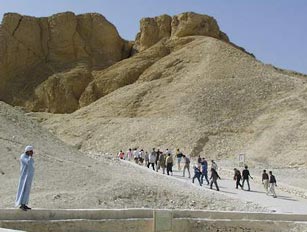
There are several answers: According to ancient Egyptian theology, a good tomb would be a place which could be considered to be the best possible "bridge" to the underworld. At the Valley of the Kings, the world almost comes to an end. Nothing grows here, and the climate is hot even through the winter. Hence it is a very obvious symbol for death. The rocks could quite easily be dug in, allowing for canals into the underworld.
Moreover, the mummy science had since long found out that the desert was an ideal place for storage of corpses.
|
|
| |
|
|